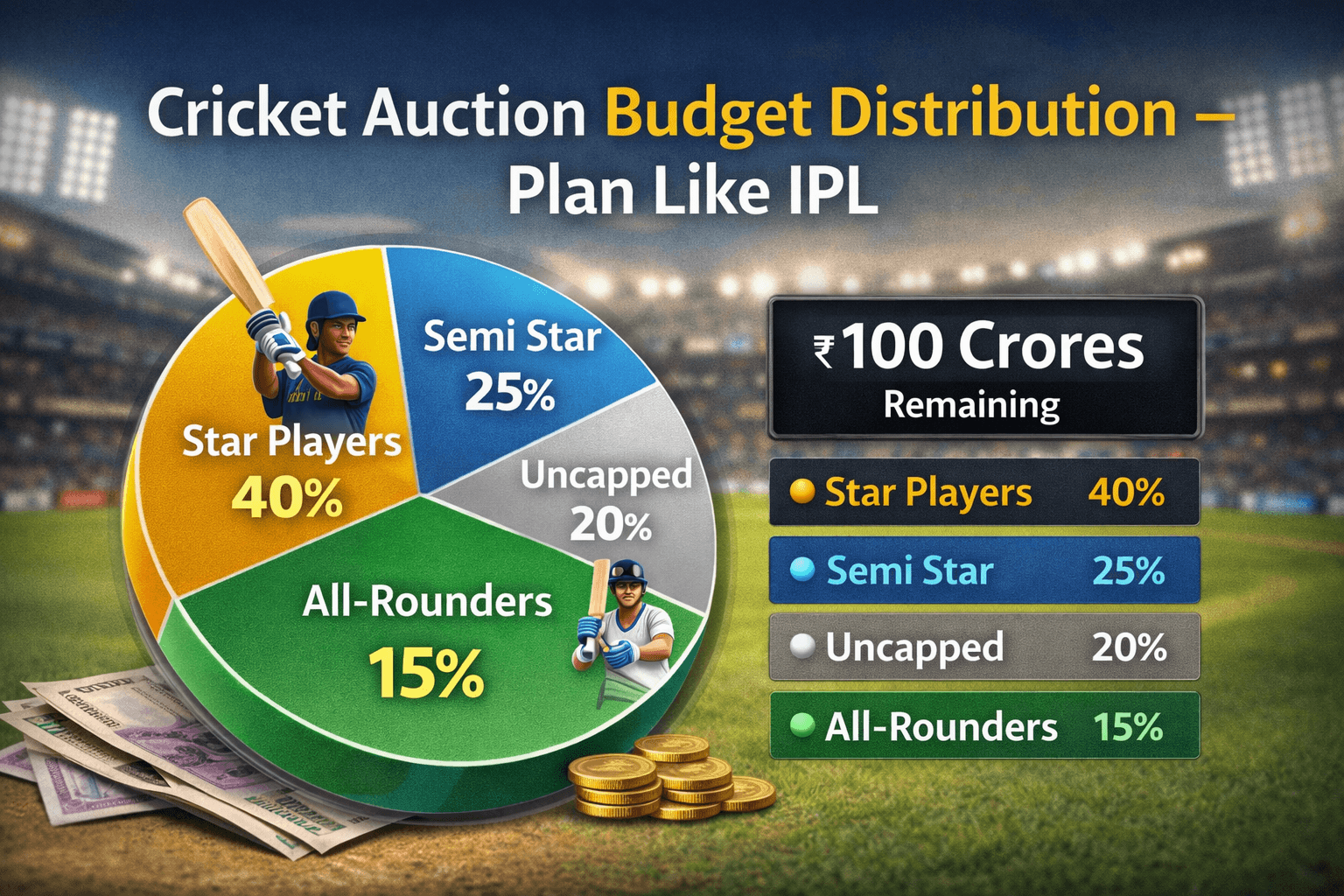
The smartest teams do not just bid well. They plan well before the auction starts.
Cricket Auction Budget Distribution — Plan Like IPL
How to plan purse allocation before auction day so teams stay competitive from marquee names to value picks.
The CricSmart editorial team creates practical content for organizers running smarter cricket auctions and tournaments.

Every cricket auction has one team that spends too much too early and then spends the rest of the evening regretting it. If you have organized or participated in even one auction, you have seen this happen.
That is why cricket auction budget distribution matters so much. Strong teams do not just react to bids. They enter the room with a plan.
This guide explains how to think about purse allocation before the auction begins, how to distribute budget across player grades, and how to avoid the most common strategy mistakes. It also shows why CricSmart's budget planning workflow is such a useful edge for organizers and team owners alike.
What is budget distribution in a cricket auction?
Budget distribution is the process of deciding how much of the team purse should go to premium players, mid-range players, and value picks. It is not about predicting exact purchases. It is about creating spending guardrails before the emotional part of the auction begins.
In simple terms, budget distribution helps answer questions like:
How much can we spend on marquee players?
How many solid mid-tier players do we need?
How much purse must remain for depth and balance?
Why teams overspend without a plan
Most overspending happens for one reason: the team enters the auction without a structure. As soon as a star name appears, owners panic, compete emotionally, and forget the rest of the squad.
That creates three problems:
Too much money goes into one or two players
The team struggles to fill key roles later
Squad balance becomes weaker over the full season
Auction hype is fun. Purse collapse is not.
How IPL-style purse planning helps
IPL franchises do not treat every player and every rupee equally. They usually think in role buckets, value tiers, and priority bands. Local leagues may work on smaller budgets, but the same strategic logic applies.
The most effective approach is to link purse planning with player grading. Once the player pool is structured, budget planning becomes much easier.
A simple framework for budget distribution
A practical starting model looks like this:
Premium spend — top players or marquee category
Core squad spend — reliable Grade A and Grade B players
Value spend — budget players, backups, and role coverage
The exact percentages will change depending on format and league style, but the logic stays the same. Do not commit too much purse to the top of the market unless you are sure the rest of the squad can still be completed well.
How format affects budget strategy
T10
T10 rewards impact players and role specialists. Teams may choose to spend more aggressively at the top because games are shorter and match-winners have outsized influence.
T15 or T20
Longer formats reward squad depth more heavily. Here, balanced purse distribution often beats star-heavy spending.
How to plan across player grades
Grade-wise planning is one of the easiest ways to make purse allocation actionable. For example:
Marquee grade gets a limited but meaningful allocation
Grade A gets steady investment
Grade B often forms the backbone of the squad
Grade C gives affordable depth and flexibility
This is exactly why CricSmart's budget distribution tool is so useful. It turns vague intuition into a visible plan.
Common purse planning mistakes
Spending too much on the first premium name that appears
Ignoring role balance
Failing to reserve enough for all-rounders or bowlers
Planning without squad size in mind
Not adjusting for the auction format
These mistakes usually feel small in the moment but become expensive later in the event.
How CricSmart helps teams and organizers plan better
CricSmart does more than track bids. It helps organizers and teams think ahead with grade-wise planning, purse visibility, and better auction structure. When budget distribution is paired with player grading and live controls, the auction becomes more strategic and less chaotic.
That is valuable for both sides of the table. Organizers create better auctions. Owners make smarter decisions.
Why this matters even in small leagues
Some organizers assume purse planning is only relevant for big franchise-style tournaments. That is not true. In fact, smaller leagues often need better budget discipline because a few bad purchases can distort the entire competition.
A simple budget framework creates fairness and improves the overall quality of squads across the event.
External context
Public coverage of IPL purse strategy from sources like MyKhel's IPL team budget tracker and broader auction reporting on IPLT20.com shows how central purse planning is to the modern auction mindset. Local leagues may use smaller numbers, but the strategy principles remain the same.
Final takeaway
If you want to build better squads, you need better purse discipline. Cricket auction budget distribution is not just an advanced tactic. It is one of the clearest signs that a team is taking the auction seriously.
The best teams do not simply chase players. They plan how to spend before the bidding begins.
Use CricSmart's Budget Distribution Tool
Real-time bidding, trading window, broadcast overlay — everything you need for a professional cricket auction.
Get Started FreeFrequently Asked Questions
Auction Budget Planning Quiz
What usually causes teams to overspend in the first part of an auction?
Written by CricSmart Editorial
The CricSmart editorial team creates practical content for organizers running smarter cricket auctions and tournaments.
Related Articles

How to Run an IPL-Style Cricket Auction Online: The Ultimate Guide
Learn how to host a professional, IPL-style online cricket auction with live bidding, virtual purses, and broadcast overlays for your local league.
How to Organize a Corporate Cricket League — The Complete Playbook
Complete step-by-step guide to organizing a corporate cricket league in India. Covers format selection, team auctions, fixture planning, logistics, and season management with digital tools.
How to Organize a Corporate Cricket League — The Complete Playbook
Complete step-by-step guide to organizing a corporate cricket league in India. Covers format selection, team auctions, fixture planning, logistics, and season management with digital tools.